
Settlement, Mediation, and Other Ways a Small Claims Case Can End Before a Final Hearing
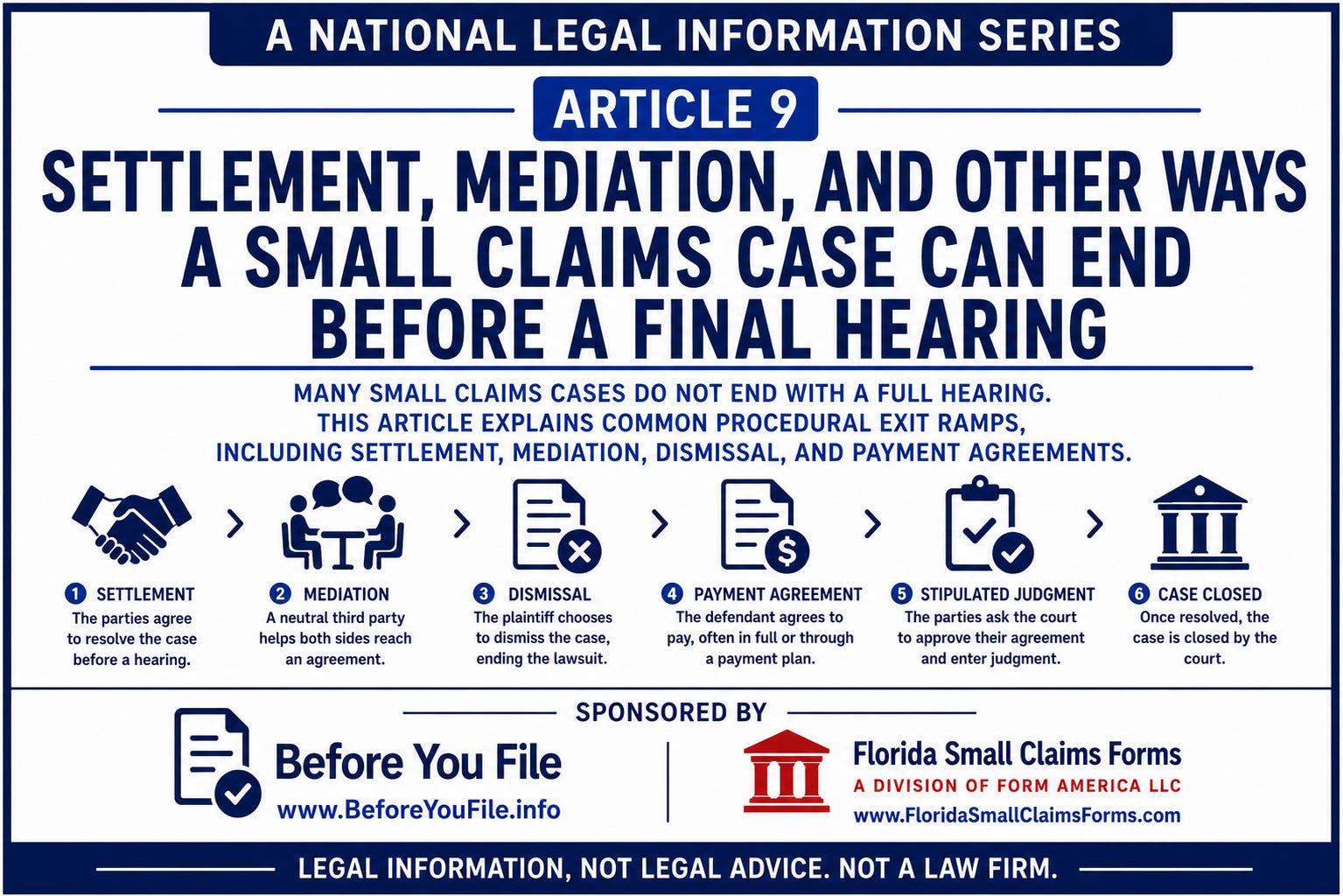
Many small claims cases do not end with a full hearing. This article explains common procedural exit ramps, including settlement, mediation, dismissal, and payment agreements.

Sponsored by Before You File and Florida Small Claims Forms, a division of Form America LLC.
A small claims case does not always end with two people standing in front of a judge while the judge decides everything after a full hearing.
That is the version people imagine because it is the version that feels like court. Someone sues. Someone responds. Both sides bring documents. The judge listens. The judge rules.
That can happen. But it is not the only way a small claims case can end.
Many small claims cases resolve somewhere along the way. Some settle before the first court date. Some settle in the hallway. Some resolve through mediation. Some are dismissed because the plaintiff decides not to continue. Some end with a payment agreement. Some result in a stipulated judgment. Some are continued while payments are made. Some fall apart because one side does not appear. Some continue to a final hearing only after every other possible exit ramp has failed.
That matters because people often walk into small claims court thinking there are only two choices: win or lose. The process is usually broader than that.
Small claims court is designed to be more accessible than regular civil litigation. It is often faster, less formal, and more direct. But it is still a court process, and court processes often include opportunities for the parties to resolve the case before a judge makes a final decision.
This article explains common procedural ways a small claims case can end before a final hearing. It is legal information, not legal advice. It does not tell you whether you should settle, whether you should dismiss your case, whether you should agree to payments, whether you should mediate, or whether a proposed agreement is good or bad for you. Those are case-specific decisions. This article explains the procedural concepts so people representing themselves understand the possible paths.
Settlement Means the Parties Reach Their Own Agreement
Settlement is one of the most common ways a small claims case can end before a final hearing.
In plain English, settlement means the parties agree to resolve the dispute themselves instead of asking the judge to decide everything. The agreement might involve payment of some or all of the amount claimed. It might involve a payment schedule. It might involve returning property. It might involve repair work, replacement, dismissal of the case, mutual releases, or some other agreed resolution that fits within the rules of the court.
The important point is that settlement is an agreement between the parties. It is not the judge deciding the case after hearing all the evidence.
New York’s official small claims handbook explains that parties may agree to settle before trial and tells them to notify the court clerk in writing and include a copy of the settlement agreement if they reach an agreement before the trial date. Florida’s small claims rules also recognize settlement before judgment, including settlements made in full or by installment payments, and state that the plaintiff shall notify the clerk of settlement.¹
That is the procedural lesson: if a case has been filed, a private agreement may not be enough by itself. The court may still need to be notified. The case may need to be dismissed, continued, or converted into an agreement that the court can enforce, depending on the local rules and the stage of the case.
People sometimes think a handshake ends the court case. It may end the personal dispute, but the court record may still be open.
Mediation Is a Structured Conversation, Not a Trial
Mediation is another common small claims exit ramp.
Mediation is a process where a neutral person helps the parties talk through the dispute and see whether they can reach an agreement. The mediator is not usually there to decide who is right. The mediator is not the judge. The mediator does not usually issue a judgment. The mediator helps the parties communicate, narrow issues, and explore possible resolution.
That distinction matters.
A person who walks into mediation expecting the mediator to declare a winner may misunderstand the process. Mediation is usually about possible agreement. If the parties agree, that agreement may be written down and submitted to the court, depending on local procedure. If the parties do not agree, the case may continue toward a hearing or trial.
California’s court self-help materials explain mediation as a process that may help parties resolve a dispute without going to trial, and California’s small claims resources include mediation as a small claims topic. Florida’s small claims rule commentary and rule materials explain that mediation may take place at the pretrial conference, and that agreements reached as a result of small claims mediation are put in writing as a stipulation.²
Mediation can be useful because it gives both sides a chance to talk in a more controlled setting. It can also be uncomfortable because each side may have to hear the other side’s version of events. But the purpose is not to relive the entire dispute for emotional satisfaction. The purpose is to see whether there is a practical resolution before the case goes further.
This article does not tell anyone whether to settle in mediation. It only explains that mediation may be part of the small claims process and may create a way for the case to resolve before a final hearing.
A Pretrial Conference May Be More Than a Scheduling Event
In some courts, the first court date may be called a pretrial conference, initial appearance, or first hearing.
People sometimes assume that a pretrial conference is not important because it is not the final trial. That can be a mistake.
A pretrial conference may be used to identify the issues, discuss settlement, refer the case to mediation, schedule a final hearing, review whether the parties are ready, or handle procedural questions. In Florida small claims practice, mediation may take place at the pretrial conference, and the person who appears for a party may need full authority to settle.³
That last phrase is important for businesses and organizations. If someone appears on behalf of a company or other party, the court may expect that person to have authority to resolve the case within the limits required by the rule or local procedure. A person who shows up but cannot make decisions may create problems.
A pretrial conference should not be treated as a throwaway event. It may be the moment when the case settles, gets scheduled for trial, gets narrowed, or takes a new procedural direction.
If the court notice says pretrial conference, the parties should read the notice carefully and understand what the court expects.
Payment Agreements Are Common, But They Need Clarity
Many small claims disputes are really payment disputes.
The defendant may not deny that money is owed. The issue may be timing. The defendant may need more time to pay. The plaintiff may want certainty. The parties may agree to installments instead of forcing the case all the way to a final hearing.
Payment agreements can be practical, but they should be clear.
A vague promise like “I’ll pay you soon” may create confusion. A more useful agreement usually identifies the total amount, payment dates, payment method, what happens if a payment is missed, whether the case is dismissed immediately or continued pending payments, and whether judgment may be entered if the agreement is not followed.
Florida’s small claims rules specifically recognize settlements by installment payments and provide that the case may be dismissed or continued pending payments. The rules also address what may happen if a party does not perform the terms of a settlement agreement before judgment.⁴
That shows why payment agreements are not just casual side deals. If a court case is already open, the agreement may need to fit into the court’s procedure.
This article does not tell anyone what payment terms to accept. It simply explains that payment agreements should be treated as formal case-related documents, not loose conversations that nobody records.
Dismissal Ends the Case, But the Details Matter
Dismissal is another way a small claims case can end before a final hearing.
A dismissal generally means the case is being ended without the judge deciding the dispute after a full hearing. A plaintiff may dismiss because the defendant paid. The parties may settle. The plaintiff may decide not to proceed. The plaintiff may realize the case was filed in the wrong court, against the wrong party, or with the wrong paperwork. The court may also dismiss a case for procedural reasons in some situations.
But dismissal is a legal event, and the details matter.
A dismissal may be with prejudice or without prejudice, depending on the jurisdiction, procedure, and circumstances. Those phrases can have consequences. A dismissal may end the case permanently or may leave room for another filing, depending on the court’s rules and the specific dismissal. This article does not interpret those consequences for any individual case because that would require legal advice.
The paperwork matters here. California’s official small claims forms page lists a Request for Dismissal and explains that it tells the court and the other side that the plaintiff does not want to go forward with the case.⁵ Other states use different forms and terminology.
If the case is resolved, the party responsible for dismissal should check the court’s required form and procedure. Do not assume that telling the other side “we’re done” automatically closes the court case.
A Stipulated Judgment Can Turn Agreement Into a Court Judgment
Sometimes the parties agree to resolve the case, but the agreement is entered in a way that allows the court to enter judgment if certain conditions are met.
This may be called a stipulated judgment, agreed judgment, consent judgment, stipulation, settlement agreement approved by the court, or another name depending on the state and local practice.
A stipulated judgment can be different from a simple private settlement because it may create a court judgment or allow one to be entered if the agreement is not followed. This can matter in payment-plan cases. A plaintiff may agree to accept payments over time. A defendant may agree to pay by certain dates. If payments are made, the case may be dismissed or satisfied. If payments are missed, the court may allow judgment or enforcement procedures, depending on the agreement and local rules.
Some Florida county mediation agreement forms show how settlement agreements may be approved by the court, with the case dismissed subject to the court retaining jurisdiction to enforce the agreement.⁶ That is not a national rule for every court, but it illustrates the larger point: some settlement documents are designed to interact directly with the court’s continuing authority.
A self-represented person should read any stipulated judgment or court-approved agreement carefully before signing. It may have consequences beyond simply “we worked it out.”
Settlement Before Court May Still Need Court Notice
Some disputes settle before the first court date.
That can be a good thing procedurally because it may save both sides time and prevent the need for a hearing. But if the case has already been filed, settlement before court does not always mean everyone can simply stay home.
The court may still expect a written notice, dismissal, stipulation, or settlement filing. The plaintiff may need to notify the clerk. The defendant may need confirmation that the case has actually been dismissed or continued. The court may have a hearing still on the calendar unless someone files the proper paperwork.
New York’s small claims handbook gives a direct example: if the parties make an agreement before the trial date, they should notify the court clerk in writing and include a copy of the settlement agreement.⁷
That is the kind of procedural instruction that matters.
If a party assumes the other side “will handle it” and the other side does not, a hearing may still occur. If one side appears and the other does not, unexpected consequences may follow. If a settlement is reached, both sides should understand what paperwork the court requires.
Settlement at the Courthouse Is Common
Some cases settle on the day of court.
This happens because the courthouse has a way of making the dispute real. Both sides are present. The hearing is close. The risk of an adverse decision is no longer theoretical. The parties may talk in the hallway, through a mediator, or under court supervision. A judge may encourage discussion before calling the case for hearing.
That does not mean anyone should feel pressured to agree to terms they do not understand. It means the court date often creates one final opportunity to resolve the case before the judge hears evidence.
If a courthouse settlement happens, the agreement should be reduced to writing in the way the court requires. The parties should know whether the case is dismissed, continued, converted into a payment agreement, entered as a stipulated judgment, or set for another date if payments are not made.
A courthouse agreement made in a hurry can create confusion later if the terms are not clear.
The Case May Continue if the Agreement Requires Time
Some settlements cannot be completed immediately.
A defendant may need thirty days to pay. A business may need time to issue a refund. A contractor may agree to complete repair work. A party may agree to return property later. A payment plan may run for several months.
When the agreement requires time, the court may dismiss the case immediately, continue the case pending performance, retain jurisdiction to enforce the agreement, or use another procedure allowed by local rules. The exact handling depends on the court.
Florida’s small claims rules recognize that a case may be dismissed or continued pending installment payments.⁸ That is an example of how courts may build settlement performance into the case timeline.
The practical point is that “settled” does not always mean “finished today.” Sometimes settlement creates a new timetable. If that happens, the parties should understand the deadlines, payment dates, future court dates, and consequences if the agreement is not followed.
If the Agreement Is Broken, the Case May Come Back to Life
A settlement agreement does not always prevent future problems.
Someone may miss a payment. Someone may fail to complete repair work. Someone may not return property. Someone may misunderstand the terms. Someone may claim the agreement was performed while the other side disagrees.
If an agreement is broken, the next step depends on the court’s procedure and the terms of the agreement. The case may be reset for hearing. A party may ask the court to enter judgment. A party may file a motion. A party may need to pursue enforcement. The court may have retained jurisdiction. Or the parties may have to take a different procedural step.
Florida’s small claims rules address failure to perform the terms of a settlement agreement before judgment and allow the court to enter an appropriate judgment or order.⁹ Again, state rules vary, but the general lesson travels well: settlement paperwork should be written clearly enough that the court can understand what was agreed to if there is a later problem.
An agreement that cannot be understood is difficult to enforce.
The Plaintiff Can Dismiss, But the Court Record Should Be Clean
If the plaintiff decides not to continue, dismissal paperwork may be needed.
That might happen because the plaintiff was paid, reached settlement, discovered the wrong defendant was named, filed in the wrong county, decided the case was not worth continuing, or reached some other resolution.
But dismissal should be done through the court’s process. A plaintiff who simply does not show up may create different consequences than a plaintiff who files a voluntary dismissal or notice as required. A defendant who believes the case is resolved should verify that the court record reflects the resolution.
Small claims court may be simpler, but the court still relies on the docket. If the docket says the case is pending, the court may treat it as pending.
Settlement Is Not a Moral Defeat
Many people treat settlement like losing.
That is not always the right way to think about it.
Settlement is a procedural tool. It allows parties to control the outcome instead of handing the entire decision to the judge. It can reduce risk. It can save time. It can create payment terms that a judgment alone may not provide. It can resolve uncertainty. It can also be a poor choice in some situations. The point is not that settlement is good or bad. The point is that settlement is one of the ways a small claims case may end.
A plaintiff may settle because getting some money now is better than getting a judgment that may be difficult to collect later. A defendant may settle because avoiding a judgment is important. Both sides may settle because the cost of another hearing, another day off work, or more stress is not worth the remaining dispute.
This article does not tell anyone when settlement makes sense. That is a legal, financial, and personal decision. It simply explains that settlement is part of the system, not a side door outside the system.
Mediation Is Not Weakness Either
The same is true of mediation.
Agreeing to mediate does not mean admitting fault. Participating in mediation does not mean agreeing to pay. Listening to a mediator does not mean giving up the right to a hearing. Mediation is a structured opportunity to see whether the case can be resolved.
Some cases will settle in mediation. Some will not. If they do not, the case may move forward.
A party who attends mediation should understand the process, listen carefully, take notes, and make sure any agreement is written clearly before signing. If a person does not understand the terms, that confusion should be addressed before the agreement is finalized.
Once an agreement is signed and filed or approved, it may become much harder to undo.
The Paperwork After Settlement Matters
The end of a small claims case often creates more paperwork, not less.
If the case is dismissed, there may be a dismissal form. If the parties reach agreement, there may be a written settlement agreement. If payments are scheduled, there may be a payment plan. If the court approves the agreement, there may be a stipulation or order. If a judgment is entered and later paid, there may be a satisfaction of judgment. If the case is continued pending payment, there may be future dates or compliance deadlines.
That is why the parties should not focus only on the money terms. They also need to understand what happens to the court case.
Will the case be dismissed now?
Will it be continued until payments are completed?
Will judgment be entered immediately?
Will judgment be entered only if payment is missed?
Will the court retain jurisdiction?
Who files the dismissal?
Who files the satisfaction?
When is the next court date?
What happens if the agreement is not followed?
Those are process questions, not legal advice. They are also the questions that prevent confusion after people leave the courthouse.
Not Every Case Settles, and That Is Why Hearings Exist
Some cases will not settle.
The parties may disagree completely. One side may believe the other is lying. One side may want a judgment. One side may refuse payment. The amount may be too far apart. The facts may be disputed. The legal issue may need to be decided. Mediation may fail. Payment terms may not be workable.
That is why the court exists.
Settlement and mediation are options in the process, not replacements for the process. If no agreement is reached, the case may proceed to a hearing where the judge listens to both sides, reviews the evidence, and makes a decision.
A person should not go into mediation assuming they must agree. A person should not go into settlement discussions assuming the judge will punish them for trying to resolve the case. These are procedural paths. The court’s job is to handle the case whether it resolves by agreement or decision.
Understand the Exit Ramps Before You Reach Them
Small claims court is often less intimidating once you realize the case may have more than one possible ending.
It may settle before court. It may resolve in mediation. It may be dismissed. It may turn into a payment agreement. It may become a stipulated judgment. It may be continued while payments are made. It may go to a final hearing. It may end in judgment. It may move into post-judgment collection or satisfaction paperwork.
Those are not loopholes. They are part of the process.
For self-represented people, understanding these exit ramps can reduce fear and prevent mistakes. A person who knows mediation is not a trial will be less confused when a mediator does not decide the case. A person who knows settlement may need written court notice will be less likely to assume a handshake closed the file. A person who knows payment plans can affect the court record will ask better procedural questions before leaving the courthouse.
Before you settle, understand what happens to the case.
Before you mediate, understand the mediator’s role.
Before you dismiss, understand the court’s paperwork.
Before you agree to payments, understand what happens if a payment is missed.
Before you leave court, understand whether the case is actually over.
Small claims court may be designed for ordinary people, but ordinary people still need to understand the exits.
Sponsored by Before You File and Florida Small Claims Forms
This article is sponsored by Before You File, available at www.BeforeYouFile.info, and Florida Small Claims Forms, available at www.FloridaSmallClaimsForms.com.
Before You File publishes general legal information to help people better understand court paperwork, court procedure, small claims cases, and self-representation before they file, respond, or appear in court.
Florida Small Claims Forms is a division of Form America LLC. Florida Small Claims Forms currently operates as a legal document forms provider for small claims matters in the 67 counties of Florida. The information in this article is written for a national audience and may be useful to readers in all 50 states, but Florida Small Claims Forms currently provides paid small claims document services only in Florida.
Legal Information Disclaimer
This article provides general legal information only. It is not legal advice. It does not tell you what you should do, what you should file, what arguments you should make, what evidence you should use, whether you should sue, whether you should settle, whether you should appeal, or how the law applies to your specific situation.
Form America LLC, Before You File, and Florida Small Claims Forms are not law firms and do not provide legal representation. No attorney-client relationship, confidential relationship, or legal document preparation relationship is created by reading this article.
Court rules, forms, filing requirements, deadlines, service requirements, hearing procedures, evidence rules, appeal rights, and judgment collection procedures vary by state, county, court, and case type. Always review the official instructions from your court, your county clerk, and your state court system. If you need advice about your specific situation, consult a licensed attorney in your jurisdiction.
Footnotes
New York’s official Small Claims Handbook explains that parties may settle before trial and should notify the court clerk in writing with a copy of the settlement agreement. Florida Small Claims Rule materials recognize settlements made in full or by installment payments and state that the plaintiff shall notify the clerk of settlement.
California Courts identifies mediation as a small claims resource and describes mediation in court self-help materials as a process where the mediator does not make decisions or force settlement. Florida small claims rule materials state that mediation may take place at the pretrial conference and that agreements reached through mediation are written as stipulations.
Florida small claims rule materials state that mediation may take place at the pretrial conference and that whoever appears for a party must have authority to settle.
Florida Small Claims Rule materials recognize settlements in full or by installment payments and state that the case may be dismissed or continued pending payments.
California Courts’ small claims forms page lists Request for Dismissal, Form CIV-110, and explains that it tells the court and the other side that the filer does not want to go forward with the case.
Florida county small claims mediation and settlement agreement forms provide examples of agreements being approved by the court, with dismissal subject to the court retaining jurisdiction to enforce the agreement.
New York’s official Small Claims Handbook says that if the parties make an agreement before the trial date, they should notify the court clerk in writing and include a copy of the settlement agreement.
Florida Small Claims Rule materials state that settlement by installment payments may result in the case being dismissed or continued pending payments.
Florida Small Claims Rule materials address failure to perform the terms of a settlement agreement before judgment and allow the court to enter an appropriate judgment or order.